Sky tonight for this month

Wednesday, July 2, 2014

Earth farthest from sun

Earth farthest from sun

4th July, 2014 – Aphelion day


We all know that earth goes round and round around the sun. Well it almost does that but there a small twist to the statement. It ALMOST goes in a circle. Thanks to Kepler, who gave us insight into how these wanderers go around the sun, all planets in our solar system travel around the Sun in elliptical orbits. It's Kepler's 1st Law. Some planets go around sun in more elliptical orbit than others. Most planets follow orbits that are more elliptical than Earth's orbit. So in a sense earth’s orbit is closest to being a circle in the whole solar family. Even then the slight deviation from a circle gives us two positions of earth when it’s farthest and closest to sun.


The orbits of Mercury (red), Earth (blue) and Mars (black). The solid lines indicate each planet's elliptical path around the Sun. The dotted lines show circular paths with the same mean separation from the center. Earth is almost exactly the same distance from the Sun at aphelion and perihelion, but the orbits of Mars and Mercury depart significantly from a circle.


On July 4th, 2014 at 15 hrs UT or at 20:30 IST, the Earth is at its farthest point from the Sun (aphelion), the distance at that time is 152,097,040 km, which is about 5 million km further away than its closest point in early January. It does appear strange that in July we have earth farthest away from sun. Isn’t it? And to top it all total energy received from sun by the globe on aphelion is around 7% less than what we receive when it is closest to the sun (perihelion).


Now you may ask if sun is farthest then why is the temperature not going down?  There are many reasons to it. Blame it on the tilt of earth’s axis. Actually, our seasons are determined by the tilt of the Earth and not by how close the Earth is to the Sun. Well that’s another story to tell.

Sunlight raises the temperature of continents more than it does oceans. (Land has a lower heat capacity than water) In July (aphelion) the land-crowded northern half of our planet is tilted toward the Sun. Aphelion sunlight is around 7% less than sunlight at perihelion, but it nevertheless does a good job warming the continents. In fact, say climate scientists, northern summer in July when the Sun is more distant than usual is a bit warmer than its southern counterpart in January.

So enjoy the warm or rather scorching sun (or cloudy day!) on 4th July as a celebration to the Aphelion day.

Friday, June 13, 2014

Full moon on Friday " the 13th" !!!!

Don't miss out !!!
Full moon on Friday " the 13th" !!!!

Friday the 13th is a superstition in western world for no reasons but still the date and the day invoke a sense of fear but here we astronomers are not bogged down by these days and dates but sometimes some interesting coincidence make these days and dates quite memorable, Today 13th June, friday happens to fit in the friday the 13th superstition but on top of that we have a full moon on this day and as the western world has a name for every full moon (though how irrational is the way they name it) and as the June moon does not rise quite high in the skies it is termed as Honey Moon (not to be confused with those nuptial knots kind!!) Lets see how much fun we can get from numbers here. Moon get full today at 4:14 UT (9:44 IST) and lets see when was the last time we had full moon on Friday the 13th and that too in june. Well the date comes to be Friday Jun 13th 1919. Interesting, isnt it? Now lets see when will it be again full moon on Friday the 13th in june? It would be in 2098!!! So lets just enjoy the number game and make astronomy more Fun by sharing these things with your friends and near ones!!! Just make sure that you tell them that Friday the 13th is just a normal day while Erath keeps on going across the sun for Billions of rounds!!!


Tuesday, June 10, 2014

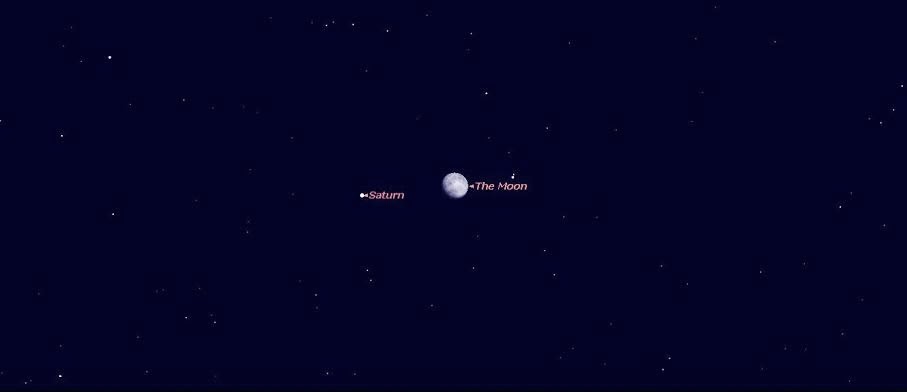
Moon close to Saturn

Moon close to Saturn today evening with in 2 degrees.


Wednesday, May 14, 2014

Saturn in conjunction with the Moon

A conjunction occurs when two astronomical objects have either the same right ascension or the same ecliptical longitude, normally when observed from the Earth.In the case of two objects that always appear close to the ecliptic such as the Moon and a planet – this implies an apparent close approach between the objects as seen on the sky.

Saturn will be in conjunction with the moon on 14-May-2014 at 18:00 IST – Right Ascension: 15.19889 and Separation: 0.57 North


Monday, May 5, 2014

SATURN OPPOSITION 2014

Lord of the Rings comes closest!!!
SATURN OPPOSITION 2014
May 10th, 2014 18:29 UT (23:59 Hrs IST)

The Lord of the rings is once again shining brightly in the eastern skies after sunset, giving us a opportunity to view this marvelous planet and its rings through a telescope. It reaches opposition at 18:29 UT on May 10th 2014 (23:59 Hrs IST). What is Opposition? Lets find out.
An object is at opposition when the sun is on one side of the Earth and the object is directly on the opposite side. The result is that the object is fully illuminated by the sun and appears disk-like. We see a great example of an opposition every month. Whenever there is a full moon, the moon is on one side of the Earth and the sun is on the opposite side.
A planet is said to be "in opposition" when it is in opposition to the sun, as seen from the Earth. At opposition a planet has the following characteristics:
·         It is visible almost all night, rising around sunset, culminating around midnight and setting around sunrise.
·         At this point of its orbit it is roughly closest to the Earth, making it appear bigger and brighter.
·         The half of the planet visible from Earth is then completely illuminated ("full planet").

Saturn oppositions occurs after a period of every one year and two weeks (378.1 days), or 29 times every 30 years. Last opposition occurred on April 28th 2013 and the next one will happen on May 23rd 2015.


How to look for Saturn?
Look for the brightest object in the eastern skies one hour after sunset and you will find Saturn glowing on the horizon. Saturn is around 18.7 seconds of arc in apparent size as seen from earth through naked eyes (in comparison Full moon is around 1800 seconds of arc). It is shining at around 0 magnitude (as bright as star Vega).
Its not that one should only look at Saturn on the opposition day, a within a few weeks before and after the opposition are in fact the best times to view Saturn this year. The Earth and sun passed through Saturn's ring plane in 2009, providing a nearly edge-on view of the rings. The ring tilt started increasing (opening wider) year by year and it will reach to a maximum tilt of 27 degrees (as seen from earth) in 2017. This year it will be showing a reasonably good view of the ring planes.


Saturn can be seen with a moderate sized telescope. You may be able to see the planet and rings clearly, depending on such variables as the power and cleanliness of your optics and eyepieces. Weather and atmospheric conditions affect the view through your telescope, too. If you are observing Saturn at low power through a small 60mm - 100mm aperture telescope it will look like a golden oval and you may not see the rings distinctly. Some small aperture telescopes will show the moon Titan, the rings and Cassini Division, the large gap between the rings of Saturn, while others will not. Larger telescopes will reveal not only the gold and brown cloud bands (bright zones and darker belts) on the planet but also the Cassini Division. Through a large telescope, you should also be able to see several of Saturn's moons in addition to Titan. It is best to view Saturn when it is highest in the sky so there will be less atmospheric dust and turbulence between you and your target.

                 Saturn captured when tilt was minimum in 2009 by SPACE team.

So what have you been waiting for? Take out your telescope out and have a look at the Lord of the rings!!!
Some extra Info about Saturn:
Saturn is the sixth planet from the Sun. It is a gas giant (also known as a Jovian planet, after the planet Jupiter), the second-largest planet in the solar system after Jupiter. Saturn has a prominent system of rings, consisting mostly of ice particles with a smaller amount of rocky debris and dust. It was named after the Roman god Saturn (the Greek equivalent is Cronos, father of Zeus). Its symbol is a stylized representation of the god's sickle
Saturn’s Moons:
Till now around 62 have been found. 52 moons have been officially named. In alphabetic order, they are: Aegir, Albiorix, Anthe, Atlas, Bebhionn, Bergelmir, Bestla, Calypso, Daphnis, Dione, Enceladus, Epimetheus, Erriapus, Farbauti, Fenrir, Fornjot, Greip, Hati, Helene, Hyperion, Hyrokkin, Iapetus, Ijiraq, Janus, Jarnsaxa, Kari, Kiviuq, Loge, Methone, Mimas, Mundilfari, Narvi, Paaliaq, Pallene, Pan, Pandora, Phoebe, Polydeuces, Prometheus, Rhea, Siarnaq, Skadi, Skoll, Surtur, Suttung, Tarqeq, Tarvos, Telesto, Tethys, Thrym, Titan and Ymir.
The dozens of moons orbiting Saturn vary drastically in shape, size, age and origin. Some of these moons have rocky surfaces, while others are porous, icy bodies. Many have craters, ridges and valleys, and some show evidence of tectonic activity. Some appear to have formed billions of years ago, while others appear to be pieces of a bigger, fragmented body. The most interesting one is Titan, the biggest of them all. Larger than Earth's Moon, Titan even has its own thick atmosphere -- the only natural satellite in the Solar System with such a luxury. During its four-year mission in this immense region, the Cassini spacecraft will extensively photograph many of these moons and collect data that will increase our understanding of their composition.
Astronomers keep finding new moons, both using ground-based observatories and cameras onboard Cassini.
The largest, Titan, is easily visible in most telescopes. Titan orbits Saturn in about 16 days. The next brightest moon, 10th magnitude Rhea, can be found orbiting about two ring diameters from Saturn. Saturns other visible moons are Tethys, Dione, Enceladus, Mimas, and Iapetus. Mimas and Enceladus are challenging to view because of their proximity to Saturns rings.